
Mini-Bee Project
A hybrid VTOL demonstrator for humanitarian air mobility.
Mini-Bee is a two-seat hybrid VTOL multicopter designed to explore fast, deployable and low-footprint air mobility for emergency, medical and humanitarian missions.
The project combines distributed electric lift, a hybrid propulsion chain, modular deployment logic and open collaborative engineering.

18
distributed rotors
2
people on board
450 km
target range
TRL4
demonstrator stage
Project purpose
Mini-Bee is designed to test a practical alternative to conventional light helicopter operations.
The goal is not to create a luxury urban aircraft, but a useful humanitarian platform: compact, deployable, hybrid, maintainable and adapted to missions where access and response time matter.
What the project brings together
A project at the intersection of aircraft design, emergency response and open engineering.
01
Hybrid VTOL architecture
A thermal engine and electric propulsion chain support distributed electric rotors, targeting endurance beyond battery-only multicopter concepts.
02
Humanitarian mission logic
The aircraft concept focuses on medical support, remote access, emergency logistics and field operations where runway infrastructure is limited or unavailable.
03
Collaborative development
Mini-Bee is developed through an open-innovation framework involving academic, industrial and independent contributors.
Technical concept
Distributed lift and hybrid endurance.
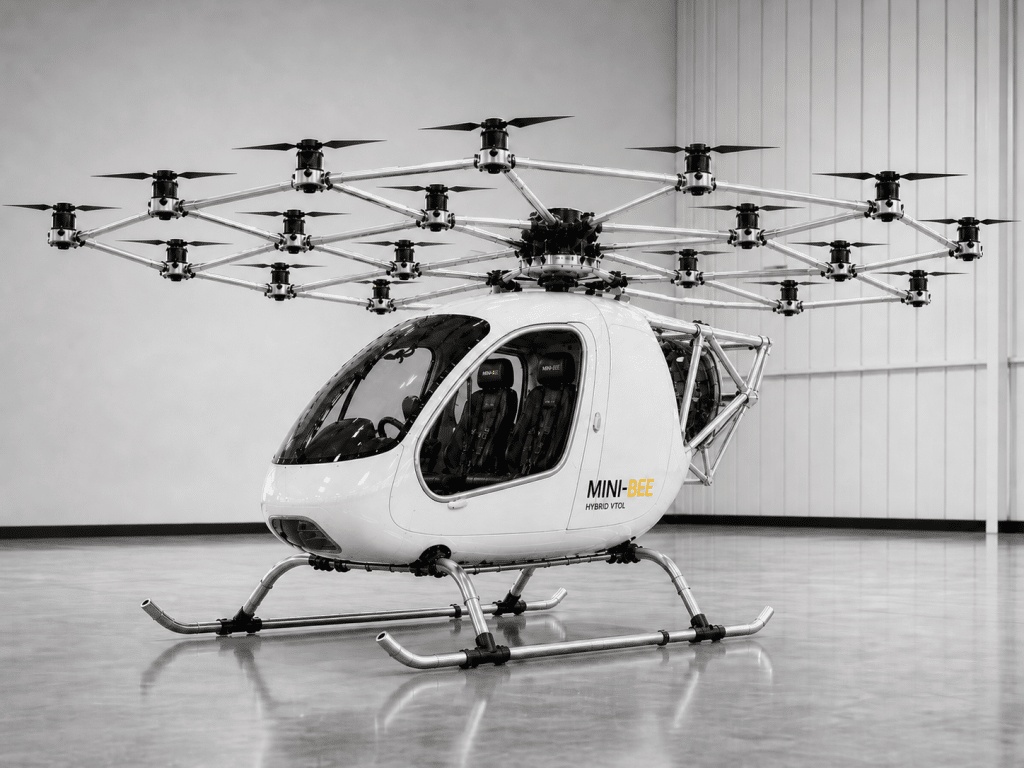
The Mini-Bee reference configuration uses distributed electric rotors to provide vertical lift and control authority. The hybrid energy system is intended to extend operational endurance and support field missions.
- Rotax 916 iS thermal engine reference
- Twin EMRAX high-voltage electric machines
- Distributed 18-rotor architecture
- Computerized flight control development
Deployment strategy
Designed to travel by civil cargo aircraft.
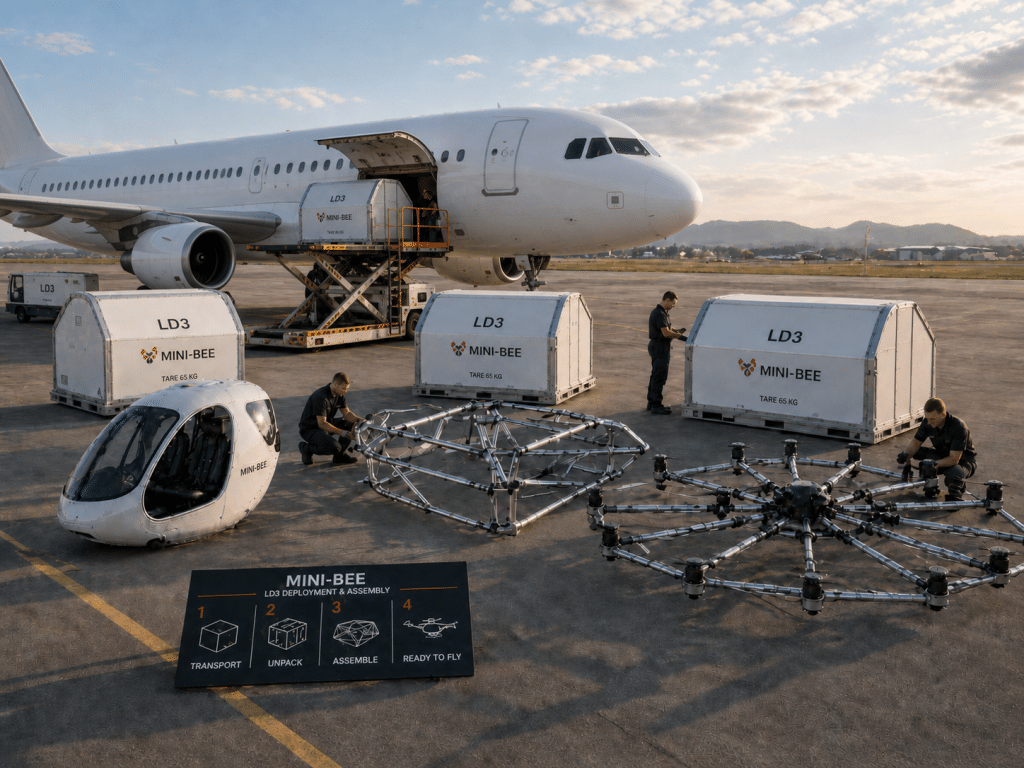
The project explores a modular deployment strategy based on LD3-compatible transport volumes. The objective is to reduce the logistical complexity normally associated with small helicopter deployment.
- Containerized transport logic
- Tarmac assembly close to the mission area
- Reduced infrastructure dependency
- Support for humanitarian deployment
Mission focus
Mini-Bee is developed for missions where fast access can change the outcome.
The project focuses on practical humanitarian and emergency applications, not speculative luxury mobility.
01
Light air ambulance
Support rapid medical access, stabilized patient transport, or movement of medical personnel in hard-to-reach zones.
02
Remote access
Reach isolated communities, mountain areas, islands or disaster zones where ground access is limited.
03
Field support
Transport urgent equipment, energy support, small cargo or essential personnel close to the operational area.
Current stage
A TRL4 demonstrator.
Mini-Bee is currently presented as a TRL4 demonstrator, with development focused on subsystem validation, flight control architecture, structural definition and hybrid power generation.
Open innovation
A collaborative engineering project.
The project is coordinated by Technoplane SAS and developed under the Lesser Open Bee License 1.3, enabling academic, industrial and independent contributors to collaborate.
Project summary
Mini-Bee is a practical research platform for accessible vertical mobility.
It brings together hybrid propulsion, distributed lift, modular deployment and open collaboration to explore a new kind of lightweight humanitarian VTOL aircraft.