
Mini-Bee · Key features
Hybrid VTOL for humanitarian and emergency missions.
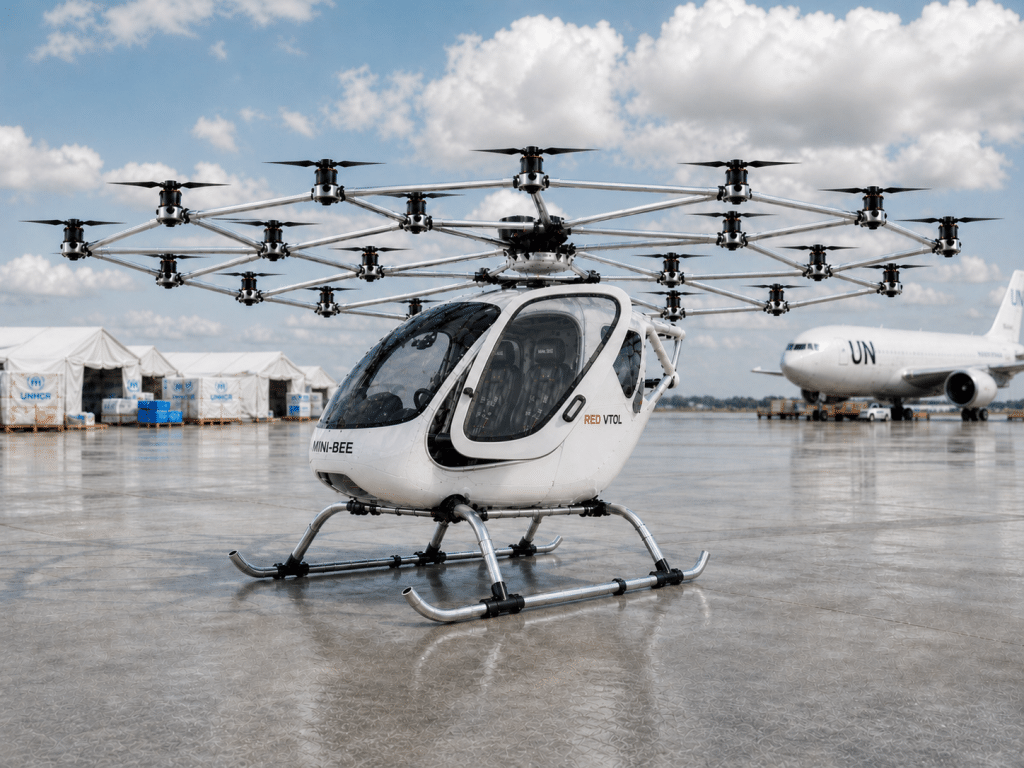
Mini-Bee is a lightweight hybrid VTOL multicopter designed for rapid deployment, medical support, and emergency operations in isolated areas.
Built around a modular architecture and an 18-rotor configuration, it combines vertical takeoff capability, operational flexibility, and reduced logistics footprint.
18
distributed rotors
2
people on board
160 km/h
cruise speed
450 km
target range
700 kg
MTOW
What makes Mini-Bee different
Hybrid propulsion, distributed lift, and mission-ready deployment.
Mini-Bee combines a hybrid powertrain, an 18-rotor layout, modular deployment logic and pilot assistance to support high-value humanitarian and emergency missions.
01
Hybrid propulsion architecture
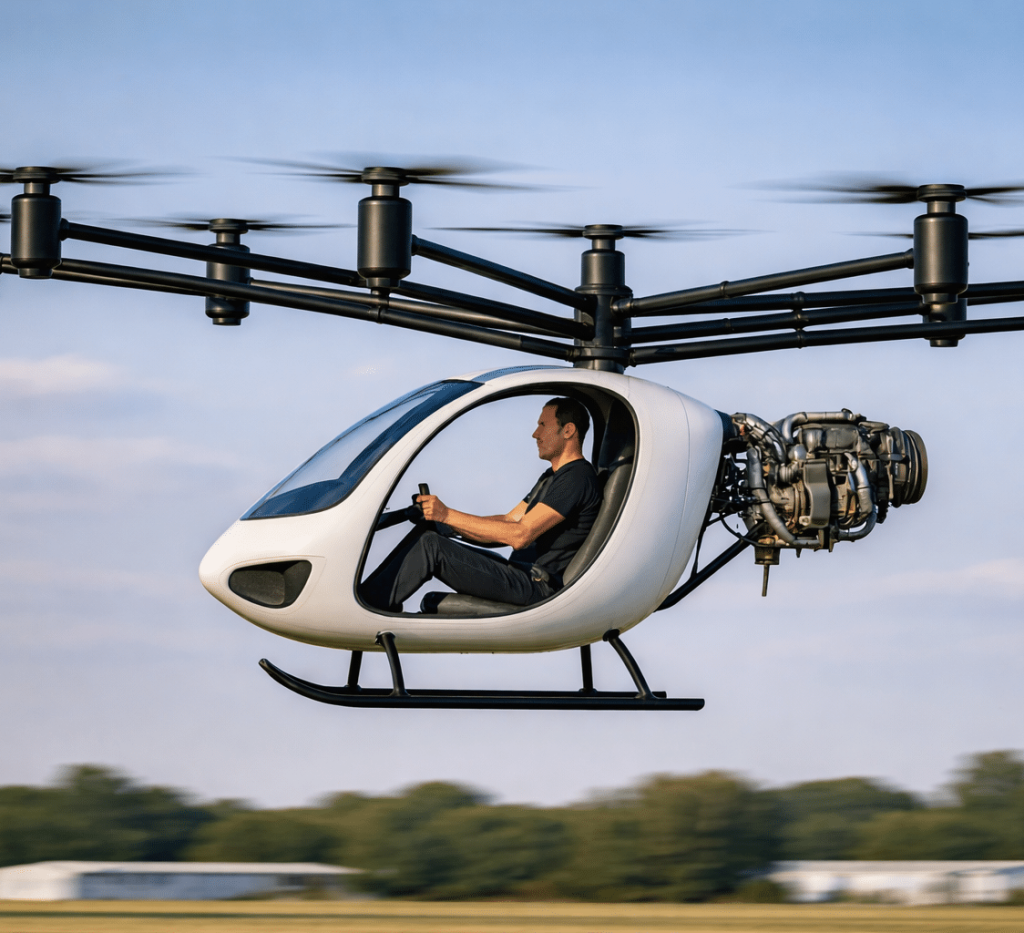
Mini-Bee combines a Rotax 916 iS engine with twin EMRAX electric machines, power electronics, and energy buffering to support a distributed 18-rotor system.
02
18 distributed rotors
The current configuration uses 18 rotors to improve redundancy, controllability, and safety. Distributed lift supports stable VTOL operations.
03
Designed for two people
Mini-Bee is configured for 2 occupants: 1 pilot and 1 passenger. The aircraft is intended for light air ambulance and emergency access missions.
Mission profile
A fast and efficient humanitarian mission profile.
The aircraft is designed around practical performance targets for emergency missions, with a compact footprint and efficient cruise capability.
- Cruise speed: 160 km/h
- Range: 450 km
- Cruise power: 100 kW
- MTOW: 700 kg

Rapid deployment
Designed to move through standard air cargo logistics.
Mini-Bee is designed to be packed into LD3 container logistics for transport by conventional civil cargo aircraft, enabling shipment to remote areas and assembly on the tarmac.
Mission-oriented structure
A modular composite tubular frame.
The aircraft uses a composite tubular frame with a modular architecture. This supports transportability, maintenance access, and field deployment.
Crash-protection intent
Built for field deployment.
The vehicle concept integrates transportability, field assembly and crash-protection intent into the overall architecture.
Flight control
Computerized controls and pilot assistance.
Mini-Bee includes computerized flight controls, joystick-based piloting, sport mode, and emergency beacon integration.
The project also includes STM32-based FCU development and sensor integration for stabilization, control, and monitoring.
Integrated avionics
Onboard monitoring and sensing.
The platform is designed around onboard monitoring and control systems, including Kanardia equipment and physical sensors such as accelerometer, magnetometer, and barometer modules.
Built for humanitarian operations
Reduced infrastructure, faster response.
- Light air ambulance missions
- Emergency access to remote areas
- Rapid humanitarian deployment
- Field operations with reduced infrastructure
Advantages versus small helicopters
A lower-footprint alternative for specific emergency missions.
01
Lower logistics burden
Mini-Bee is designed for containerized deployment, unlike conventional light helicopters that are harder and more expensive to move by civil cargo.
02
Hybrid energy approach
The propulsion concept combines thermal and electric subsystems to support efficient mission performance and new architectural possibilities.
03
Safety-oriented lift
The 18-rotor layout is intended to improve redundancy and fault tolerance compared with single-main-rotor configurations.
Open development
A collaborative engineering framework.
Mini-Bee is developed under the Lesser Open Bee License 1.3, with contributions from academic and industrial partners.
Current status
TRL4 demonstrator.
- Project name: Mini-Bee — Hybrid VTOL
- Current maturity: TRL 4
- Technical coordinator: Technoplane SAS
- Mission focus: humanitarian and emergency operations
- Reference configuration: Rotax 916 iS, twin EMRAX system, 18 rotors, 2 people on board
Mini-Bee in one line
A modular hybrid 18-rotor VTOL for low-footprint emergency mobility.
Mini-Bee is designed to bring fast, deployable air mobility to humanitarian and emergency missions.